
On April 23, 2026, the DOJ and DEA announced a final order placing medical cannabis through state-licensed programs into Schedule III. For over 50 years, medical cannabis was classified as a Schedule I substance, meaning it was considered to have no accepted use in medical care under federal law.
During this time, patients across the country, including those in Texas, were experiencing life-changing relief—from being bedridden to walking again, from nonverbal to speaking, from sleepless nights to rested. All along, medical cannabis has been helping people take their lives back.
Today, the gap between policy and real-world patient experience is finally closing, and this change is expected to open the door to progress in healthcare, research and patient access. So what does Schedule III actually mean for Texans? Read on to understand what this change could mean for patients.
What Schedule III Means for Texans
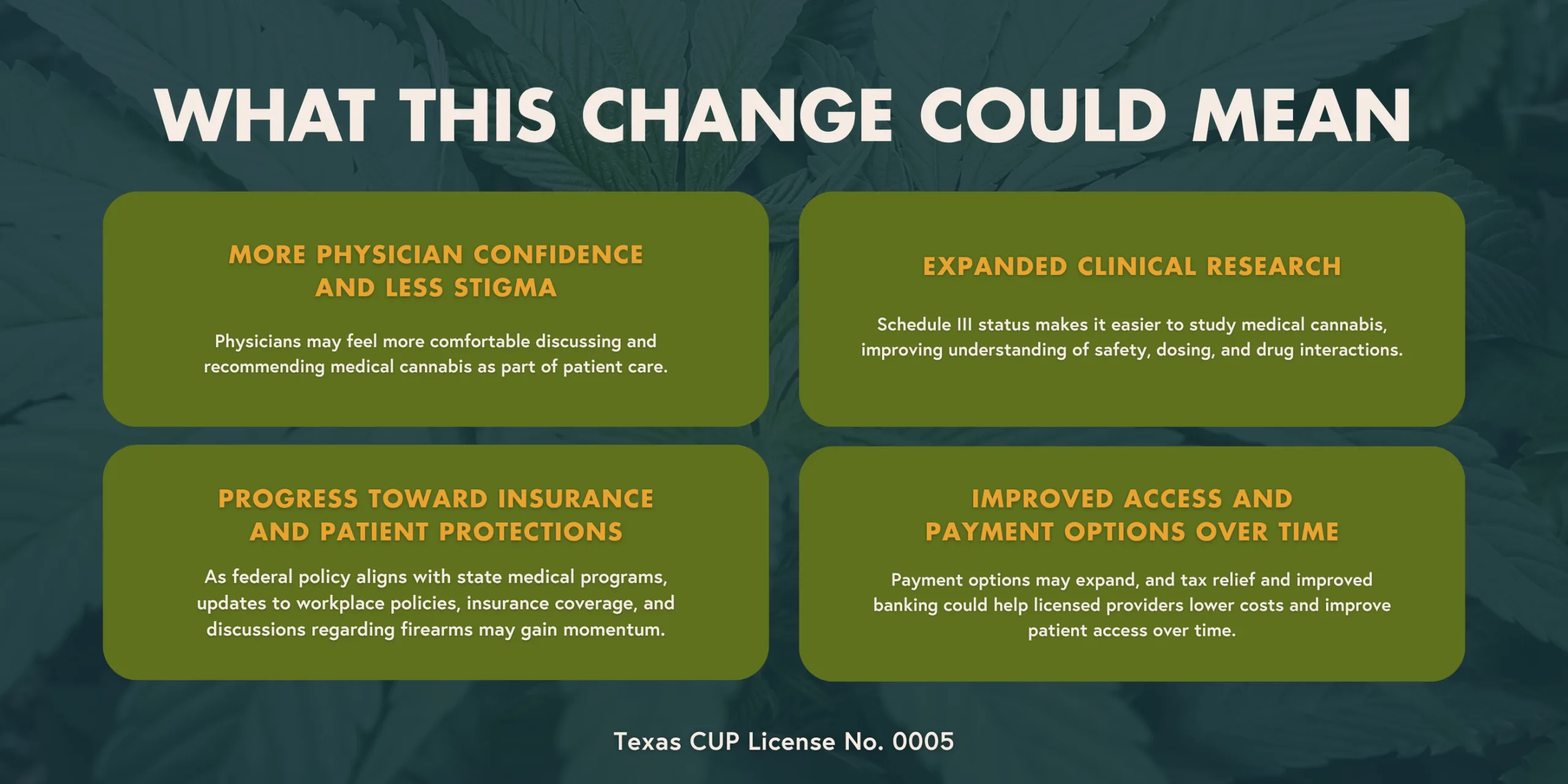
Schedule III is a federal classification for substances that have accepted medical use. The reclassification of medical cannabis to Schedule 3 indicates that federal law is beginning to align with state medical cannabis programs and recognizes its medicinal benefits. With medical cannabis now classified as a Schedule III substance, we may start to see:
- More confidence and less stigma in healthcare: Physicians may feel more comfortable recommending medical cannabis.
- More clinical research: The move to Schedule III can make it easier to study medical cannabis safety, dosing and drug interactions.
- Clearer workplace and federal policy guidance: Employers and federal programs may begin updating their policies on medical cannabis use.
- Potential insurance coverage: This change could support future policies on insurance coverage as research expands and medical cannabis becomes more recognized in healthcare.
- Firearm policy discussions: The Bureau of Alcohol, Tobacco, Firearms and Explosives (ATF) has proposed revisions to Form 4473 that would remove specific references to medical marijuana. Additionally, a recent Supreme Court ruling stated that the federal government cannot prosecute a Texas man for possessing firearms and using marijuana. These discussions at the federal level indicate meaningful progress toward stronger Second Amendment protections for medical cannabis patients.
- Financial and operational support for licensed dispensaries: Tax relief and improved banking options could help licensed providers lower costs over time.
Medical Cannabis and Firearm Ownership
Firearm ownership has been one of the biggest questions for medical cannabis patients in Texas. While federal policy is still developing, recent updates with the move of medical cannabis to Schedule III are sparking broader policy discussions and potential movement toward clearer protections for patients.
After the DOJ and DEA issued a final order to place state-licensed medical cannabis into Schedule III, the Bureau of Alcohol, Tobacco, Firearms and Explosives (ATF) proposed updated language to the federal firearm purchase form 4473. Previously, the form stated that marijuana use remained unlawful regardless of whether it was used for medical or recreational purposes. The proposed update would remove prior reference to medical marijuana and instead state that recreational marijuana use remains prohibited under federal law Bureau of Alcohol, Tobacco, Firearms and Explosives, 2026)
On June 18, 2026, the U.S. Supreme Court unanimously ruled that the federal government could not prosecute a Texas man under federal law, 18 U.S.C. § 922(g)(3), for possessing firearms and using marijuana. The Court found that marijuana use alone was not enough to justify applying the firearm restriction law in his case (Supreme Court of the United States, 2026).
While the Court did not rule that all cannabis users can own firearms in every circumstance, it suggests a positive shift in federal policy. Combined with the move of state-licensed medical cannabis to Schedule III and proposed ATF updates to Form 4473, the ruling shows growing recognition that medical cannabis use alone should not automatically strip patients of their Second Amendment rights.
When will Schedule III changes take effect?
The shift of medical cannabis to Schedule 3 is already moving things forward. While some of these changes will take time, this update on a federal level sets the stage for real progress across healthcare, insurance coverage, patient protections, research and more.
For Texans, medical cannabis is still accessed through the Compassionate Use Program and eligibility, prescriptions and purchasing remain the same today.
Is cannabis federally legal now?
Cannabis is not federally legal. Medical cannabis in Texas and certain FDA-approved products are now Schedule III substances, meaning they are accepted for medical use. Adult-use or recreational cannabis and marijuana outside state medical cannabis programs remain a Schedule I substance.
Can Texas VA doctors prescribe medical cannabis?
While VA doctors currently cannot prescribe medical cannabis, the reclassification of medical cannabis may allow for improvements to veteran access and create pressure for updated VA policy. Veterans may still participate in the Texas Compassionate Use Program through a qualified Texas physician. Participating in state medical cannabis programs will not result in the loss of VA benefits for veterans.
Can medical cannabis patients own guns?
Participation in the Compassionate Use Program does not, in itself, disqualify an individual from obtaining or maintaining a License to Carry (LTC), according to the Department of Public Safety (DPS). Federal firearm policy is still developing, and a recent Supreme Court ruling in favor of gun ownership for cannabis users suggests policy is moving toward clearer protections for medical cannabis patients. Learn more about firearms and participating in the Compassionate Use Program here.
Will insurance now cover medical cannabis?
Insurance coverage may be possible in the future now that medical cannabis is a Schedule 3. Insurance coverage typically depends on FDA approval, medical necessity criteria and insurer policies.
Can I use a credit card now that medical cannabis is a Schedule III?
Payment options for medical cannabis may expand over time now that it is a Schedule III substance. As federal policy begins to align more with state medical cannabis programs, banks and payment processors may become more comfortable accepting credit for medical cannabis purchases. For the time being, payments for medical cannabis can be made via AeroPay, debit, ACH, cash or check.
Does the use of medical cannabis affect federal housing guidelines?
The Schedule III change may give the U.S. Department of Housing and Urban Development (HUD) a basis to revisit federal housing policies. However, their current policies remain the same at this time.
Can patients using prescribed opioids use medical cannabis?
Medical cannabis may be included in treatment plans for some patients using opioids, at the physician’s discretion. For patients already managing chronic pain, Schedule III may help remove some of the barriers that have made physicians hesitant to prescribe medical cannabis for pain management. Additionally, as research develops, more physicians may begin prescribing medical cannabis for pain relief.
How do the regulations on medical cannabis research change under Schedule III?
Now that medical cannabis is classified as a Schedule III substance, significant barriers will be reduced, making it easier for researchers to study medical cannabis, including its dosing, safety, drug interactions and its use for specific conditions. Additionally, the Department of Justice (DOJ) announced a new administrative hearing scheduled to begin on June 29, 2026, regarding the broader rescheduling of marijuana.
What changes will occur for medical cannabis businesses?
Section 280E has prevented medical cannabis businesses involved with Schedule I substances from deducting ordinary business expenses. Now that medical cannabis is a Schedule III, qualifying state medical marijuana licensees may be able to take ordinary business deductions going forward.
For patients, this does not automatically mean prices drop overnight. But over time, tax relief could help licensed operators invest more in access, products, education and patient support.
Can any doctor prescribe medical cannabis now that it is Schedule III?
Physicians registered in the Compassionate Use Program can currently prescribe medical cannabis for more than 150 conditions. A patient must receive a prescription from a qualified CUP physician, and the prescription must be entered into the Compassionate Use Registry of Texas. The Schedule III change may encourage more physicians to participate in the program.
Does the move of medical cannabis to a Schedule III substance change the eligibility for Texans?
The move of medical cannabis to a Schedule III substance does not change eligibility criteria for Texans. Medical cannabis will still be available through the Compassionate Use Program. To qualify for a medical marijuana prescription, Texans must:
- Be a Texas resident
- Have a qualifying condition
What’s Happens Next for Medical Cannabis?
With a federal hearing scheduled for later this year, additional changes are on the horizon. The classification of medical cannabis as a Schedule III substance creates momentum for more research, clearer policies and improved access.
This change most of all marks a significant shift toward recognizing medical cannabis as a legitimate medicine. As medical cannabis policies grow, we’re here to help Texans understand their impact and will keep you updated every step of the way.
How to Get Medical Cannabis in Texas
Texans with a qualifying condition can meet with a physician to get a medical cannabis prescription. To get started:
- Schedule an appointment with a physician registered to prescribe medical cannabis in Texas.
- The physician will determine your eligibility and if approved, they will enter your prescription into the Compassionate Use Registry of Texas (CURT).
- Once your prescription is submitted, place an order online or call 512-614-0343, and choose from over 18 pickup locations across Texas.
Texas Original offers various ways to save on medical cannabis. New medical cannabis patients get 20% off their first order and earn TXOG reward points on every completed medical cannabis purchase. Veterans and first responders receive 20% off every order.